


Suddenly Solo: Your Key Employee Just Walked Out

It starts with a conversation you probably didn’t see coming. A resignation letter. A few awkward words.


And then, that long, uncomfortable silence.


You try to smile, nod, wish them well.


But inside, the panic is already starting to build.


It hits you all at once:


The invoices they chased? That’s yours now.

The client questions they fielded? That’s your inbox dinging every five minutes.
The dozen tasks they did without ever needing to be asked? But what’s worse, you’re not even sure what half of them were.

You tell yourself it’ll be okay, but you know you’re lying. Because when your team is small, one departure doesn’t just feel like losing a limb, it feels like losing a loved one.

Like a trusted friend walking out of your life without warning. Like a crushing breakup, only worse. Why? Because this relationship wasn’t personal, it was structural.

They didn’t just support you emotionally; they held up part of your business.

And now that part is gone.

If you’ve read Michael E. Gerber’s, The E-Myth Revisited, you’ll remember Harry and Elizabeth. They weren’t just characters; they were the backbone of someone else’s dream. And then one day, they walked out.

No malice. No drama. Just a quiet decision that left the business owner stunned. Suddenly face-to-face with everything they didn’t know how or maybe didn’t want to do.

That’s the moment you might be in right now.

You don’t just feel sad. You feel abandoned, overwhelmed, and vulnerable.

You weren’t just blindsided. You were unprepared.

Suddenly, the business you’ve built, and fought with all your might to keep afloat, is threatening to tip over because one person walked out the door.

The work hasn’t disappeared. It’s just landed squarely on your shoulders.

And now, you’re stuck asking the one question every overwhelmed business owner, VP, director or manager eventually faces: “How am I supposed to do all of this, and still grow my business or meet my goals?”

It’s a fair question. But growth isn’t even the biggest risk right now.

What keeps you up that night, and the next night, is the gnawing fear of what happens if you drop the ball.

Because suddenly this isn’t just about working longer hours. This is about losing customers. This is about missing a payroll deadline and the trust that comes with it. This is about breaking a contract because a project gets delayed, and facing legal action you’re not prepared to handle.

And it’s not just accounting. The fallout hits everywhere:
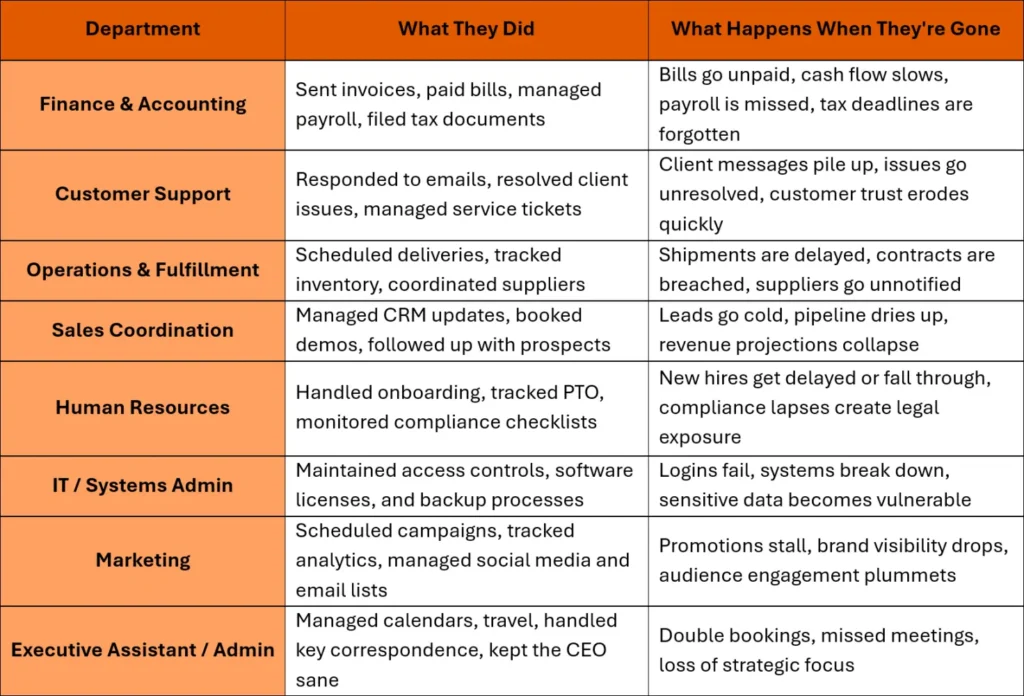
Ok, maybe for some, this may feel overly dramatic. If you’ve ever been here, then you know the pain is real, the fear is real and the impact on your life is all too real!

And damn it! You knew you should have been prepared, had everything documented, every process and microtransaction mapped out in detail so it would be easy to pick up the pieces until you made that new hire.

Let me stop and say, “I feel for you! I really do, I’ve been here and its NOT FUN!” First the bad news, the pain isn’t going to disappear overnight. Two Cadillac margaritas may help you forget until the next morning, but it still hurts when you wake up.

Now some good news, pain, while so very uncomfortable, can be a motivator like no other. Now is the time to take action, before the shock fades and you begin to acclimate to the new normal, take action! But, Brent, what the hell am I supposed to do? I have all this extra work, and I can’t get it all done and well, I just want to quit, is that an option?

Okay, you’re in the Mess – Time to Work Through It
First, take a few deep breaths. No really, right now, inhale, exhale, inhale, exhale. You’re still in the eye of the storm, and it’s okay to feel the pressure. Ready for the really good news: you’re not powerless. And you don’t have to solve everything at once.

What you do need is a structured recovery plan, and a little help turning that pain into progress.

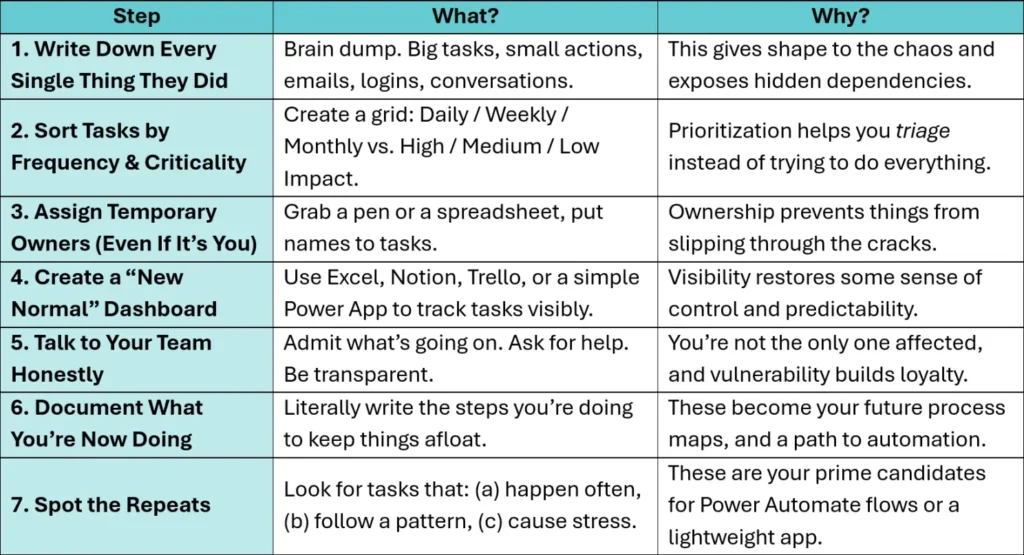
Recovery Roadmap: 7 Grounding Steps to Get You Moving Again
Do You Feel a Tiny Bit Better?
You should. But if you don’t yet, that’s okay too. Relief doesn’t always arrive with a fanfare. Sometimes it just shows up quietly as a little less chaos, a little more clarity.

Here’s the truth: it is getting better, even if it doesn’t feel like it right now.

Why? Because a few days ago, you didn’t even know what you were up against. And now…

You’ve got a task list.
You’ve mapped out key workflows.
You’ve started documenting steps instead of relying on memory.

That’s not just progress. That’s momentum. And momentum is how you climb out of the hole and back to solid ground.

Before we move on, I want to pause with you for a moment and focus on Step #1: Write Down Every Single Thing They Did.

In a perfect world, you’d already know what everyone on your team does, all the time. But we don’t live in utopia, and that’s okay. Here’s my suggestion: start by writing down everything you can quickly remember. Don’t overthink it. Don’t try to make it perfect. Just begin. The real key? Don’t stop there.

Over the next few days, as you encounter moments of friction, when a task gets missed, or you find yourself asking, “Wait, who used to do this?” Treat that moment like a signal. When you feel that little prick of pain, don’t just grit your teeth and move on. Grab your list and write it down.

That simple act gives you back a bit of control. It’s a small win in a messy moment.

Then, once you’ve handled the task or solved the issue, go back to the list and capture the steps you followed. That’s your first process map, built in real time, by necessity, but designed to last.

What If You Could Go Beyond “Back to Normal”?
Yes, getting to status quo is a win. Now that you’ve done all this hard work, what if you made it count for more?

What if the next time you make a hire,

they’re not guessing what success looks like,
they’re not shadowing for three weeks to learn “how things get done,”
and they’re not set up to burn out doing everything manually?

What if their first day feels smooth, productive, and welcoming?

This is where automation starts to work its quiet magic.

You’ve already done the hardest part: you started the process of untangling the invisible systems that ran your business. Now, automation lets you solidify those systems. Let’s make them run whether that key person stays, leaves, or takes a well-deserved vacation.

Choose your mindset:
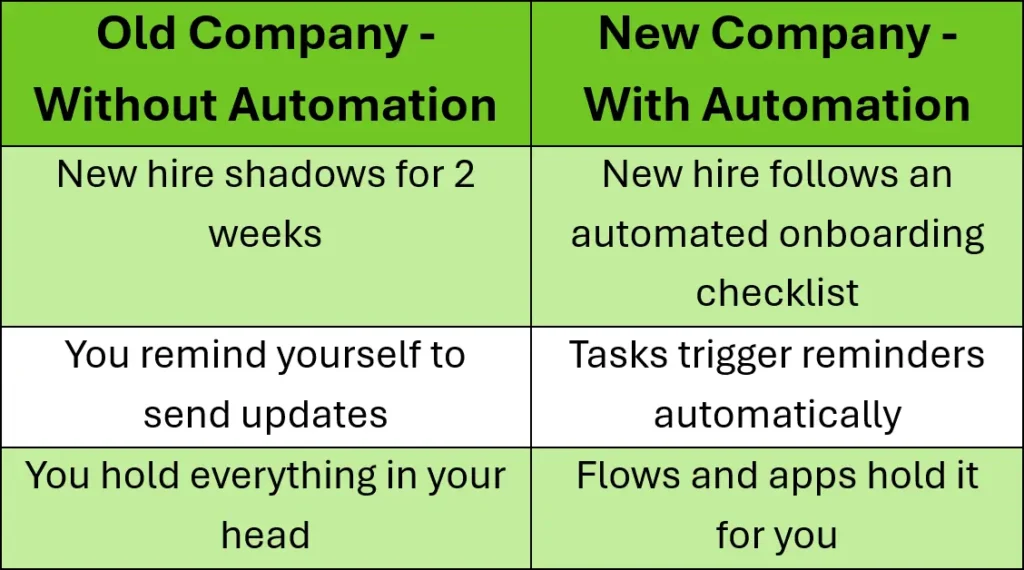
Automation doesn’t mean “replace people.” It means you stop rebuilding the wheel every time someone joins, or leaves, your team.

Your Automation Starter Kit (Even If You’re Not a “Tech Person”)
You’ve done the hard part.  You have pulled the pieces together after a key person left. Now it’s time to give those pieces a skeleton. A structure. A system.

This is where to use automation.

No, you don’t need to be a developer. You don’t need to write code. You just need to know what’s supposed to happen, and tools like Power Automate can help you make sure it actually happens.

Prefer another platform? That’s okay too. Whether it’s Zapier, Make, or another automation tool, the ideas below still apply.

5 Simple Automations That Make a Big Difference When You’re Short-Handed
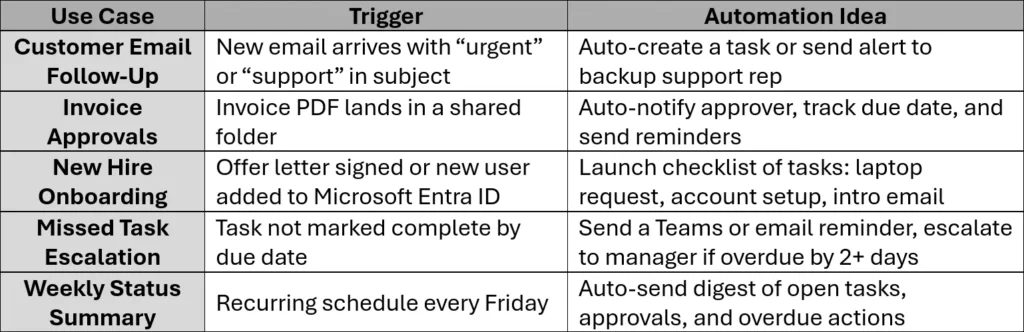
Each of these flows can be built in Power Automate with low-code tools. You can start small, just one flow, and watch how much smoother things get.

And here’s the best part: Once the process is in place, it runs quietly in the background. No more remembering. No more reminding. No more rebuilding.

You Don’t Have to Do This Alone
Right now, you might still be picking up the pieces. You’ve started to document. You’re seeing patterns. Maybe even sketching ideas for automation. But we know when time is short, and pressure is high, it can be hard to move from intention to execution.

That’s when Citizen’s Consulting Group can help.

Whether you need:

An experienced Business Analyst to help map processes and uncover the best opportunities for automation, or
A seasoned Power Platform Developer who can turn your ideas into working apps and flows.

We’re here, not just as consultants, but as partners in your recovery.

We understand what it feels like when a key person walks out and everything lands on your desk. We’ve been here. And we’ve helped businesses just like yours build systems that don’t break when people leave.

You deserve to focus on what matters, not on constantly putting out fires. Let’s build something that gives you peace of mind, restores control, and prepares you for the next time life throws a curveball.

It starts with a conversation you probably didn’t see coming. A resignation letter. A few awkward words.

And then, that long, uncomfortable silence.

You try to smile, nod, wish them well.

But inside, the panic is already starting to build.

It hits you all at once:

The invoices they chased? That’s yours now.
The client questions they fielded? That’s your inbox dinging every five minutes.
The dozen tasks they did without ever needing to be asked? But what’s worse, you’re not even sure what half of them were.

You tell yourself it’ll be okay, but you know you’re lying. Because when your team is small, one departure doesn’t just feel like losing a limb, it feels like losing a loved one.

Like a trusted friend walking out of your life without warning. Like a crushing breakup, only worse. Why? Because this relationship wasn’t personal, it was structural.

They didn’t just support you emotionally; they held up part of your business.

And now that part is gone.

If you’ve read Michael E. Gerber’s, The E-Myth Revisited, you’ll remember Harry and Elizabeth. They weren’t just characters; they were the backbone of someone else’s dream. And then one day, they walked out.

No malice. No drama. Just a quiet decision that left the business owner stunned. Suddenly face-to-face with everything they didn’t know how or maybe didn’t want to do.

That’s the moment you might be in right now.

You don’t just feel sad. You feel abandoned, overwhelmed, and vulnerable.

You weren’t just blindsided. You were unprepared.

Suddenly, the business you’ve built, and fought with all your might to keep afloat, is threatening to tip over because one person walked out the door.

The work hasn’t disappeared. It’s just landed squarely on your shoulders.

And now, you’re stuck asking the one question every overwhelmed business owner, VP, director or manager eventually faces: “How am I supposed to do all of this, and still grow my business or meet my goals?”

It’s a fair question. But growth isn’t even the biggest risk right now.

What keeps you up that night, and the next night, is the gnawing fear of what happens if you drop the ball.

Because suddenly this isn’t just about working longer hours. This is about losing customers. This is about missing a payroll deadline and the trust that comes with it. This is about breaking a contract because a project gets delayed, and facing legal action you’re not prepared to handle.

And it’s not just accounting. The fallout hits everywhere:

Ok, maybe for some, this may feel overly dramatic. If you’ve ever been here, then you know the pain is real, the fear is real and the impact on your life is all too real!

And damn it! You knew you should have been prepared, had everything documented, every process and microtransaction mapped out in detail so it would be easy to pick up the pieces until you made that new hire.

Let me stop and say, “I feel for you! I really do, I’ve been here and its NOT FUN!” First the bad news, the pain isn’t going to disappear overnight. Two Cadillac margaritas may help you forget until the next morning, but it still hurts when you wake up.

Now some good news, pain, while so very uncomfortable, can be a motivator like no other. Now is the time to take action, before the shock fades and you begin to acclimate to the new normal, take action! But, Brent, what the hell am I supposed to do? I have all this extra work, and I can’t get it all done and well, I just want to quit, is that an option?

Okay, you’re in the Mess – Time to Work Through It
First, take a few deep breaths. No really, right now, inhale, exhale, inhale, exhale. You’re still in the eye of the storm, and it’s okay to feel the pressure. Ready for the really good news: you’re not powerless. And you don’t have to solve everything at once.

What you do need is a structured recovery plan, and a little help turning that pain into progress.

Recovery Roadmap: 7 Grounding Steps to Get You Moving Again

Do You Feel a Tiny Bit Better?
You should. But if you don’t yet, that’s okay too. Relief doesn’t always arrive with a fanfare. Sometimes it just shows up quietly as a little less chaos, a little more clarity.

Here’s the truth: it is getting better, even if it doesn’t feel like it right now.

Why? Because a few days ago, you didn’t even know what you were up against. And now…

You’ve got a task list.
You’ve mapped out key workflows.
You’ve started documenting steps instead of relying on memory.

That’s not just progress. That’s momentum. And momentum is how you climb out of the hole and back to solid ground.

Before we move on, I want to pause with you for a moment and focus on Step #1: Write Down Every Single Thing They Did.

In a perfect world, you’d already know what everyone on your team does, all the time. But we don’t live in utopia, and that’s okay. Here’s my suggestion: start by writing down everything you can quickly remember. Don’t overthink it. Don’t try to make it perfect. Just begin. The real key? Don’t stop there.

Over the next few days, as you encounter moments of friction, when a task gets missed, or you find yourself asking, “Wait, who used to do this?” Treat that moment like a signal. When you feel that little prick of pain, don’t just grit your teeth and move on. Grab your list and write it down.

That simple act gives you back a bit of control. It’s a small win in a messy moment.

Then, once you’ve handled the task or solved the issue, go back to the list and capture the steps you followed. That’s your first process map, built in real time, by necessity, but designed to last.

What If You Could Go Beyond “Back to Normal”?
Yes, getting to status quo is a win. Now that you’ve done all this hard work, what if you made it count for more?

What if the next time you make a hire,

they’re not guessing what success looks like,
they’re not shadowing for three weeks to learn “how things get done,”
and they’re not set up to burn out doing everything manually?

What if their first day feels smooth, productive, and welcoming?

This is where automation starts to work its quiet magic.

You’ve already done the hardest part: you started the process of untangling the invisible systems that ran your business. Now, automation lets you solidify those systems. Let’s make them run whether that key person stays, leaves, or takes a well-deserved vacation.

Choose your mindset:

Automation doesn’t mean “replace people.” It means you stop rebuilding the wheel every time someone joins, or leaves, your team.

Your Automation Starter Kit (Even If You’re Not a “Tech Person”)
You’ve done the hard part.  You have pulled the pieces together after a key person left. Now it’s time to give those pieces a skeleton. A structure. A system.

This is where to use automation.

No, you don’t need to be a developer. You don’t need to write code. You just need to know what’s supposed to happen, and tools like Power Automate can help you make sure it actually happens.

Prefer another platform? That’s okay too. Whether it’s Zapier, Make, or another automation tool, the ideas below still apply.

5 Simple Automations That Make a Big Difference When You’re Short-Handed

Each of these flows can be built in Power Automate with low-code tools. You can start small, just one flow, and watch how much smoother things get.

And here’s the best part: Once the process is in place, it runs quietly in the background. No more remembering. No more reminding. No more rebuilding.

You Don’t Have to Do This Alone
Right now, you might still be picking up the pieces. You’ve started to document. You’re seeing patterns. Maybe even sketching ideas for automation. But we know when time is short, and pressure is high, it can be hard to move from intention to execution.

That’s when Citizen’s Consulting Group can help.

Whether you need:

An experienced Business Analyst to help map processes and uncover the best opportunities for automation, or
A seasoned Power Platform Developer who can turn your ideas into working apps and flows.

We’re here, not just as consultants, but as partners in your recovery.

We understand what it feels like when a key person walks out and everything lands on your desk. We’ve been here. And we’ve helped businesses just like yours build systems that don’t break when people leave.

You deserve to focus on what matters, not on constantly putting out fires. Let’s build something that gives you peace of mind, restores control, and prepares you for the next time life throws a curveball.